After some contemplation, I have come to the conclusion that John Crowley's Little, Big is one of the most challenging books I have ever read. Not challenging in regards to difficulty, but in that it challenged my imagination and entire thought process. I quickly realized this book was by no means just a simply page turner, but, as the saying goes, the further in you go, the bigger it gets. I could take nothing at face value - there was always something more, some deeper connection, some hidden foreshadowing or analogy. It was fascinating, but also frustrating, because I know there were so many things I missed, and yet I do not think it humanly possible to pick up on everything after one reading. For example, August senior. I had just assumed he'd walked off the face of the earth, but then after class discussion and further analysis, I learned he had indeed become Grandfather Trout - a rather important conclusion that I did not initially realize because of the complexity with which it was interwoven. In addition, being a rather left-brained individual, I struggle with such fantastical books. Hand me a straight up fantasy book and I'll survive because the entire world is "make believe," but in Little, Big, the overlap between the fairy world and reality was a challenge for me to wrap my mind around. I simply could not really grasp the whole separate spheres but overlap. So yes, I can honestly say that this novel was one of the more challenging books I have ever read.
There is one aspect of the book that I was absolutely taken with and, despite my best efforts, could not come to a concrete conclusion about. The Tale. Is there actually a drawn out plan previously composed that sets the greater world in motion, or is it just what people choose to lean on, afraid of being fully responsible for their own lives? Yes, I appreciate that there are the fairies and the tarot cards and the analogy of the Fates, but the Tale is so much more. Here lies my issue with accepting that the Tale is strictly of the inner spheres' creation and reflects on the inhabitants of Edgewood, it is initially stated that the fairies have no interest in human activities, they only care about their own. Therefore, it seems inconceivable to me that the fairies would care to the point of planning out the human lives. However, in the book "The Fairies' Parliament," when Lilac is trying to convince Auberon and George to come with her to the other world, it says, "'It won't come out right,' Lilac said softly. 'The Tale,' she said, even more softly" (Crowley 464). Coming from the fairy world, Lilac must know what is happening there, and here she lets on that the Tale is indeed their greater plan. However, there is the option of it not turning out right, signifying that humans do still have some control over their own lives. In addition, there is a section titled "Land Called the Tale" when they arrive in the fairy world. It is described as, "The Tale was behind them. And it was to there they journeyed" (Crowley 532). Under this new understanding, I believe that this meant they had escaped the impact of the Tale, because they were at it's origin, demonstrating how the fairy world is the source of the Tale. I am still not 100% sure what to make of the Tale and how concrete it really is, but in the last book I did come to appreciate it as an impact on the inner world on the outer.
So I guess in closing I would like to just give a little thanks to John Crowley. He wrote a truly captivating book that expanded my horizons and stretched my brain. If you ever happen to see this blog, Mr. Crowley, thank you for your incredible work.
Tuesday, October 23, 2012

Thursday, October 11, 2012
A Mirrored Memory
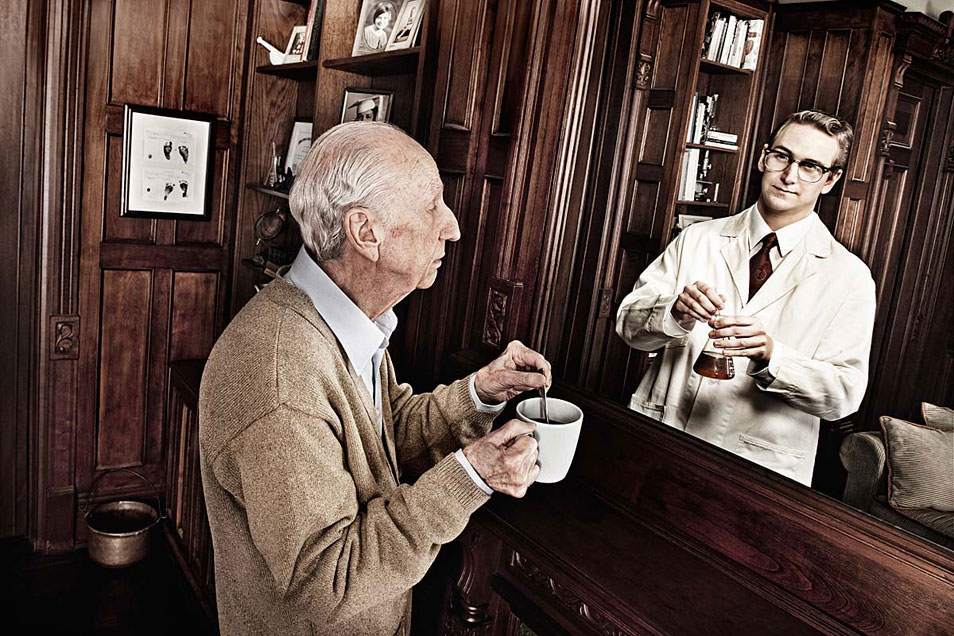
The other day, as I was casually killing a few minutes browsing about the internet, I happened across this website that reminded me of Lewis Carroll's Through the Looking Glass. Photographer Tom Hussey was hired by the pharmaceutical company Novartis to create a series of advertisements for a drug that helps patients maintain long term memory during Alzheimer's.

Included in this post are a few samples of Hussey's work for the campaign, but to see more click here.
This reminded me of Alice's adventure immediately due to the power of the looking glass. In Alice's story, she is transported to another crazy world, while in Hussey's art the mirror provides a transport back to a time that was. I thoroughly enjoy this, because a mirror is thought of as just reflecting the present, but both Carroll and Hussey see it as a means for taking what is, and bending it to an alternate reality. In these cases, the looking glass serves as a reminder or what was or what could be, and yet still maintains a bent version of reality. For example, Alice believes her kitten was the queen - a connection between the mirror world and her life - and the man in the first picture sees his coffee cup as a flask - a connection between his current life and his life in the past as a scientist.
I know this subject matter jumps a bit back to Alice and Through the Looking Glass in our first few weeks of class, but when I saw these images I could not resist posting about them. Hopefully they can serve as a reminder to us of the beauty and fantasy of looking past the current and obvious.
Questions for John Crowley
1. The Washington Post Book World commented that Little Big is "... a love story of very great intensity..." However, I take it to be an intense story that involves more sexuality as opposed to love. What role did you intend for love to play in this book? Is it a love story or a story that involves sexuality?
2. Do you believe in the Tale? If not, was it challenging to write a novel so centered around it?
3. In regards to the faeries, why is it that only some people can see them, and those that can see them are not necessarily those that most desire to see into the inner spheres?
4. Jumping back to the beginning, why did you start of the entire book with Chesterton's quote "Men are men, but Man is a woman"? Did you intend to make this a book that largely addresses and questions gender roles?
5. On the contents page, it says:
6. Do you genuinely believe that the further in you go, the bigger it gets? Was there something in your world that occurred to cause you to make this realization, or did it just work with the book? Was this the primary basis when you initially began writing the book? How did it evolve over the writing period?
2. Do you believe in the Tale? If not, was it challenging to write a novel so centered around it?
3. In regards to the faeries, why is it that only some people can see them, and those that can see them are not necessarily those that most desire to see into the inner spheres?
4. Jumping back to the beginning, why did you start of the entire book with Chesterton's quote "Men are men, but Man is a woman"? Did you intend to make this a book that largely addresses and questions gender roles?
5. On the contents page, it says:
LITTLE, BIG
or,
The Fairies' Parliament
is that an alternate title you came up with? Does it / how would The Fairies' Parliament fit as a more adequate title of the novel?6. Do you genuinely believe that the further in you go, the bigger it gets? Was there something in your world that occurred to cause you to make this realization, or did it just work with the book? Was this the primary basis when you initially began writing the book? How did it evolve over the writing period?
Thursday, October 4, 2012
Be Happy

"The Things that Make us Happy
Make us Wise." (Crowley 22).
This quote from John Crowley's Little Big stopped me dead in my tracks while reading. Especially in the reading for a college class - where we are supposed to be gaining wisdom, but do not associate it with happiness - I was unsure what to make of it.
It brought up three questions:
1. What is happiness?
2. What is wisdom and how does is vary from knowledge?
3. How does happiness create wisdom?
So I guess the first step is to figure out what is happiness. At this point it would be easy to jump to the dictionary definition, but it is too broad. There are so many types of happiness; one can be joyful, excited, gleeful, blissful, ecstatic, pleased, and the list just goes on and on. Therefore, I suppose the question of "What is happiness?" might just be a bit too broad.
However, I do believe we can then ask the different question of what makes us happy? I think it is safe to say that happiness comes with non-material goods. Looking back on my life, I find, and I hold this to be true for humanity as a whole, that true happiness comes with interactions. Whether these interactions are between people or with the environment or with some sort of challenge being faced, it is what pushes us and we are able to overcome and grow that makes us truly happy. That can be a friend just being there for you and having a good laugh. It can be reaching the top of a mountain in spite of its steep terrain. It can be finally solving that math problem you have been staring at for days. It is when we are challenged and growing through success that we find true, lasting happiness. Material goods can help us on our way and be a tool to be happy, but ultimately they cannot push us and encourage us in the way that others and ourselves can.
This then leads to the question of wisdom. I distinguish between wisdom and knowledge and wisdom in the way that wisdom has to do with understanding, whereas knowledge is recitation of fact. As August puts it in Little, Big, "Now knowledge was there to be had, real knowledge, knowledge of how the world operates and what must be done to operate it. Operate" (Crowley 102). August is out to know, but he lacks the curiosity to understand what it is that way. In my opinion, knowledge is comprised of fact, and wisdom goes deeper than the facts to discover how they work together and why it is.
So how do the things that make us happy also make us wise? Experience. It is the experiences that make us happy that also make us wise. In doing the things that make us happy (as discussed above), we create a greater understanding of the workings of the world because we are experiencing them first hand. In addition, when something makes us happy, we are naturally drawn to it and want to know more about it in hopes of maximizing our happiness, and, therefore, discover more about it and its inner-workings and begin to understand it, growing wiser. However, sometimes our understanding boils down to the appreciation that it cannot be fully understood, and there we are wise in learning the vastness of the world and the limits of our own human minds.
I believe it all boils down to experience. It is what Dr. Bramble seeked in regards to the fairies, a first hand experience, and yet he could not get it. Therefore, he knew some facts from Violet, but he failed to appreciate the whole existence because he could not see for himself. He has knowledge, but not wisdom. In the end, happiness is an outcome of experience, and an advocate for more experience, so the things that make us happy allow for a deeper understanding that makes us wise.
Thursday, September 27, 2012
"The End"
That's all folks!
Now isn't that just cute? At the end of the cartoon adventure, a little humor and then a polite dismissal, telling us the show is over.
Yet, we always want more. When a story is over, we ask for another, preferring to be lost in an alternate reality to our current reality. The example of the abused princess who loses her glass slipper at the ball of her true love comes to mind.
First came the original story, "The Little Glass Slipper," in the french book Histoires ou contes du temps passé by Charles Perrault.

Somewhere along the lines, Disney decided it made quite the lovely tale, and created the animated movie Cinderella.
However, this wasn't enough for fans of the story, so the movie A Cinderella Story was created, based on the original plot.
However, even the modern remake wasn't enough, and we "needed" Another Cinderella Story.
I'm just going to be brutally honest for a second and say that the remixes of the original are dreadful. But that's beside the point. Anyways, if we just keep wanting to hear stories, why do we want an end?
Every child (and if not you, then your siblings, cousins, neighbors, etc.) loves to be read a bed time story. Without fail, what happens when the story is finished if the kiddo is not yet asleep? He demands another. If we have this inherent love for story, even as a child, why can we not just continue an endless story?
I think it is because of our desire for order and knowing. Even if we are as right-brained and sporadic as it gets, we still enjoy a little closure so that we can close the lid and store the story. We want a neat little stack of completion rather than a long, never ending chain that does not neatly fit in anywhere. It would grow so big that it could connect with everything, and yet not fully with anything else. It would be possible to draw comparisons between parts, but never a whole, and that can be frustrating.
In terms of knowing, we are a curious people. We want to know how things turn up, does it work, and what could we expect if it were to happen to us. In a long story, our impatience gets to us, and rather than enjoy the story, we want to see the outcomes, and we begin to strive for the ending instead of enjoying the adventure of getting there. In addition, I believe we are afraid of getting confused if the story is long. We take length to mean complexity and confusion full of twists and turns, but in reading The Arabian Nights, I have found my preconceived notions of this to be false. Through the stories, I am swept up, but every individual tale is short enough and tied back to the upper levels quickly enough that I am not lost or confused, but continue to look forward to the next layer within the overarching story.
This is where the art of storytelling comes in. A good storyteller is able to weave an intricate individual tale, while still keeping the connection between the other stories clear so that the listener is able to simply enjoy and focus on one story without fear of losing the bigger one. Therefore, I believe that we don't necessarily want an ending, we just want clarity.
Tuesday, September 25, 2012
How the Elk Got his Antlers
“Daaaaaaad! Dad dad dad dad dad!”
“Shhhh Sam, it’s not even light out yet! Want to scare the elk away before we even see any?”
“No…..”
“It’s just a bit further. Here, let me take your gun and you shimmy on up that ladder. There you go, easy now, stay quiet. Alright, scoot over and I’ll sit on the edge.”
“Hey Dad?”
“What buddy?”
“I’m bored. And cold. And I don’t want to go hunting.”
“Just wait, I promise – Shhhhh! Look Sam!”
“Ohhhh! What do I do?”
“Just leave it; look at how beautiful it is! Ah, there is goes. Look at that. Back to his family I bet!”
“Dad?”
“Yeah?”
“Why do elk have such big antlers? Like, doesn’t it seem like it would bend your head over?”
“Well, it’s kind of a long story kiddo….
Back before any man had even set foot in the Americas, when the forests grew wild and untamed, and survival of the fittest existed in its rawest form, the elk had bare heads. This meant they had little protection against big predators and the herds were quickly dying down. So one day, one brave elk, after witnessing his brother be killed by wolves, decided to sneak away from the herd and find a way to save his family. He wandered for days through the woods, running and hiding from predators, until, eleven days later, he accidentally stumbled into a hole and twisted his ankle. Bellowing in pain, he resigned himself to his fate and sat, waiting for the end to come.
However, the elk was in luck! Up popped a little field mouse, all cute and grey and miniscule.
“Whatcha doing?” piped the mouse.
“Waiting to die,” moped the elk.
“Well... I can help with that!” squeaked the little mouse.
“Yeah right,” replied the elk, “because it’s not like I’m a million times bigger than you.”
But just as he said this, the little mouse began to scuttle around, weaving together grasses and leaves until he had formed a bandage he wrapped around the ankle.
“Wow, that actually does feel better! Thanks little guy. I’ll just head on home now, I’ve done enough damage without accomplishing anything. Want a life? Climb on and I’ll get you back,” said the elk.
“Thanks!” exclaimed the mouse, and he scampered up until he was sitting on the elk’s shoulder as they slowly made their way through the forest. “What were you doing so far out here anyways?”
“Long story...” sighed the elk. “Basically, the same horrible things happening everywhere are happening to the elk. I came out in search of something to help us protect ourselves.”
“Hmmmm that’s tough. I’m pretty sure the only reason I’m still alive is because I’m so small that they don’t even see me!” said the mouse. “Oh wait, I have an idea!”
“Oh yeah? And what’s that?” questioned the moose sarcastically. “Unless you happen to know some mystical giant creature willing to protect the herd, we’re out of options.”
“No, silly!” squealed the mouse, “We’ll just get you your own protection!”
“What do you mean?” replied the elk.
“Well, a few months ago I was foraging for some berries and nuts and just little goodies to bring home to my family, when suddenly, seemingly out of nowhere, these wolf pups appear and start chasing me around like I’m some sort of toy! So, of course I hop away as fast as a can, and who do I run into, but a beaver!
This beaver saw my plight and quickly ushered me into this lodge. However, we could still hear the pups scratching away away at the roof.
Seeing my anxiety and knowing I’m a chewer, the beaver pulled out a fresh branch and we both got to gnawing.
“You know,” he said, “I remember a time when things weren’t this bad. The water had always been safe - I could swim out in the open and build as many dams as I wanted, but then, one day, everything changed. I was swimming to my latest project, when out of no where I heard this huge splash behind me. It was bigger than any fish, and I was used to only myself and the fish inhabiting this waterway. Startled, I turned around, and what should I see, but a huge dog head sticking out of the water moving towards me! It was a wolf! They had previously stuck to the land, but now it seemed my precious territory was at risk.”
“What did you do?” I asked.
“The only thing I could,” he replied, “I slapped my tail, dove under water, and swam as quickly as I could back to my lodge! Since then, I’ve only ventured out when resources are at a minimum, which is why I was out and happened to find out. It’s those darn pups, they’re so unpredictable!”
“Well, I cannot thank you enough for saving me!” I squeaked. “I’m quickly discovering, as you’ve found, what it’s like to live in constant fear. Hey, look what all this nervous chewing turned out!”
Looking down, I saw that, out of nerves, we had chewed the bark off the branch until it was completely smooth, and each successive limb was at a point. We laughed at it then, but now that I think about it, I think the prongs could offer some protection!”
“Really?” questioned the elk. “But how could I carry it? Hooves don’t really allow for much holding.”
“Maybe we could strap it to you somehow!” exclaimed the mouse. “Here, turn here, and I’ll get it.” So he scampered down off the elk’s back and ran to the beaver hut, quickly returning dragging the elaborately carved branch.
“We could tie it to your back,” said the mouse.
“But you’re riding there,” retorted the elk.
“Oh right. Hmmm where else could it go?” asked the mouse.
The elk replied, “What if we just stick it to my head?”
“Good thinking! Oh wait, one branch is too heavy, let me quick chew it in half so we can try to balance it,” thought the mouse.
So the mouse quickly split the branch into two pieces and secured them to the elk’s head with a vine. The elk thanked the mouse and they headed off.
On their journey back, something incredible happened! It was as if the branches grew into the elk’s head, and became attached. Over time, more and more elk adopted the practice after discovering the prongs frightened off predators. And that, kiddo, is why the elk have antlers.”
“Well jeez Dad, I hope you don’t expect me to believe all of that!”
“Oh come on now Sam, I swear it’s real!”
“Whatever Dad, but shhhhh! Look, here comes another one!”
Thursday, September 13, 2012
Fabulous Monsters
Hearing Dr. Lynda Sexson speak on Lewis Carroll's Through the Looking Glass was thoroughly enlightening and allowed me to see the seemingly frivolous story of Alice's adventures on the other side of the glass as a deeper, layered, thoughtful adult story.

When looked at through various lenses, the more complete idea surrounding the fable is revealed, disclosing a more complex message than the simple enjoyable bedtime story could ever seem to hold.
For example, viewed in regards to Carroll's personal life, the questions of eros and religion become prominent, for Carroll's adoration for little girls and the church were prominent in his life. Knowing this, the character of Alice, who is based on a child Carroll knew, suddenly takes on a different light. She is not just a fragment of the imagination, but a real girl, combining Carroll's reality with the fictional world through the looking glass. It brings a sense of possible reality, or at least a connection between reality and imagination, to the other world.
Another element of the story that interested me was the idea that everyone is "edible." In general, I would say that objects are personified to give them a sense of life and superiority over other beings and objects. However, Carroll does this differently. Everything is brought to life so that everything is not necessarily "equal," but at least on the same level of being. It is then, because there are no overbearing stratification, that everything is dispensable. Even Alice, a human being, is told by the unicorn, "If you'll believe in me, I'll believe in you." The tables seem to be turned, an animal, and not just any animal, but a fictional animal, is telling a human he will only believe in her if she first believes in him. The rational food chain no longer exists; everyone is on the same level.
Dr. Sexson made the comment that a child is a fabulous monster. This struck me, and I have not been able to stop thinking about it. Though I have yet to reach any concrete solution, the first thing that always pops into my mind is Max from the book and movie Where the Wild Things Are.
Max is a fabulous monster, and not because he dresses up in his costume and lives among monsters, but because he is a child who we cannot fully anticipate or understand. The word "monster" has such a negative connotation, but, according to Merriam-Webster, a monster can also be one who deviates from normal behavior, and another definition is one who is highly successful. I believe both of these apply to children, and these definitions are often tied together in children. Kids are prone to do what they want, whether or not it is the social norm or even socially acceptable. However, it is often because of their individuality and creativity that they find success. I think back to Max, and how while most people create fantasy worlds full of rainbows and castles, his world is full of beasts, and it is here he finds success in the form of finding a place he belongs and can call home.
Children often have not yet conformed to societal norms, which would cause them to be monsters. And yet they are fabulous in that they use this monstrosity to be creative and insightful and be truly happy and content in the irrational. In the end, even though I do not fully understand it, I have already fallen in love with the term fabulous monster, and believe children manifest its meaning quite perfectly.
Subscribe to:
Posts (Atom)