Looking back at this semester, our seminar reminds me of Alice's journey in Through the Looking Glass. Even at it's most basic, the class was the mirror through which we traveled to discover another world. In the world of recursive structures, there are many connections to our external world, we just fail to to take the time and notice them. When Alice first finds herself on the "inside" of the looking glass, it is the same, and yet different. Characters and settings are exaggerated, and it is not until she seems to wake up and believe that the Red Queen was her kitten, Kitty, that the link is established in Alice's mind.
This class really did a similar thing for me. Through literature, we jump into a different world, influenced by our own interpretations of the outer world. The readings and discussions allowed me to look back at my own world from the inside of the mirror (in this case, the seminar), and I discovered the interconnectedness and recursive layers in my own life. For, indeed, life is not just disconnected events, but is all connected and could not meaningfully exist without being woven to others.
This might be getting a bit cliche, but it is the recursion and conscilience that create meaning. I can do something or think something, but unless it is tied to others, there is no effect. That is not to say that everything needs a concrete link to a cause and resulting effect, but I do believe everything has at least a weak connection to something else, or else it wouldn't be in existence.
Now leaving the class and returning to the "traditional" side of the mirror, I can look back at all we did in class from the outside point of view. I learned so much in this class. Not only specifically about the books we read, but history, theology, psychology, language, mythology, science, math, and a sprinkling of just about everything, or so it seems. Not to mention the fact that I know have a list of books to read about a mile long - at least I will not be bored over winter break!
I guess what it all boils down to in the end, is that the moral of the story is the story. As we all experienced in this seminar, there is always another layer to be discovered, making it impossible to perfectly sum things up in a little thematic statement. I remember a connection I made in the beginning of the semester back to the changing story of Cinderella. I thought I had traced it all the way back to the beginning when it was a french fairy tale, only to have Dr. Sexson trace it all the way back to mythology, and remark that it goes on even farther than that. Therefore, we have to enjoy the story for what it is - always striving to learn more, but appreciating we will never be fully able to grasp the entire thing, for that would require complete knowledge and understanding. We must learn what we can, but never think it is over.
Thank you, Dr. Sexson, for an incredible class and opening my eyes to the beauty, complexity, and challenge of not only the literature we read in class, but of everything everywhere.
Thursday, December 6, 2012
Tuesday, November 20, 2012
Making Your Own Choices?
So a few nights ago a good friend and I got to debating the simple question of the meaning of life. Of course, thing quickly got heated and eventually progressed to the deeper question of whether life is predestined or we have the right to choose. Though I'm still not sure what I think, my preferred choice of freedom of choice was challenged by my friend's faith in determinism.
Determinism is a complex theory that, in a very rough summary, says choice is just a fragment of our imagination, and what we hold to be choices are actually results of prior states of affairs. So in a roundabout way, our choices are merely results of previous things, we only think we choose them. It is a complex theory, so to better understand it I would suggest checking out this website.
Perhaps a picture best describes it.
The only way I was able to even somewhat wrap my mind around this idea was to think of Alphonse and how his choices were not really his own. He believed he was making choices considering the actions of others, but, in actuality, his "choices" were all predetermined responses to the calculated actions of others to have him "choose" the response, even though it was previously determined. Our choices are not actually choices, but are really necessary consequences of prior "choices," which were really effects of previous events, and so on.
My struggle with this theory is where did this start? Determinism differs from predestination in that "choices" are a result of previous, whereas, with predestination, "choices" have been made for us by a greater power, but still can be more than just a calculated and necessary response to the previous. But with determinism, what was the original "previous?" Originally someone had to make a choice so that the was a triggering event to start the necessary chain of reactions. I also find it hard to believe that choices are just necessary responses, because while I do believe that you can predict someone's decision based on outside influences, I think humans are far too complex for their mental capacity to be a simple response without any look to the future.
I do believe this theory places a new spin on my approach to The Tale and the question of predestination I'm addressing in my final project.
Determinism is a complex theory that, in a very rough summary, says choice is just a fragment of our imagination, and what we hold to be choices are actually results of prior states of affairs. So in a roundabout way, our choices are merely results of previous things, we only think we choose them. It is a complex theory, so to better understand it I would suggest checking out this website.
Perhaps a picture best describes it.
| The prior decisions act as a machine in which the effect is shown under the illusion of choice. |
The only way I was able to even somewhat wrap my mind around this idea was to think of Alphonse and how his choices were not really his own. He believed he was making choices considering the actions of others, but, in actuality, his "choices" were all predetermined responses to the calculated actions of others to have him "choose" the response, even though it was previously determined. Our choices are not actually choices, but are really necessary consequences of prior "choices," which were really effects of previous events, and so on.
My struggle with this theory is where did this start? Determinism differs from predestination in that "choices" are a result of previous, whereas, with predestination, "choices" have been made for us by a greater power, but still can be more than just a calculated and necessary response to the previous. But with determinism, what was the original "previous?" Originally someone had to make a choice so that the was a triggering event to start the necessary chain of reactions. I also find it hard to believe that choices are just necessary responses, because while I do believe that you can predict someone's decision based on outside influences, I think humans are far too complex for their mental capacity to be a simple response without any look to the future.
I do believe this theory places a new spin on my approach to The Tale and the question of predestination I'm addressing in my final project.
Thursday, November 8, 2012
Final Project: The Tale
While reading Little, Big, I was fascinated by the idea of The Tale and the tarot cards, mostly due to their sense of predestination. The Drinkwater family's concern with knowing the future of their lives and the ability to predict it was foreign to me, yet lured me in. I understand the value in knowing the future to be able to adequately prepare, but does that not take away some of our independence and freedom as humans? Are we really cast in some fated play without knowing it or do we create our own destinies? These are just a few reasons I would like to more deeply look at The Tale and the idea of predestination, which I suppose will end up tying to the greater idea of fate.
A few things I will discuss in my paper:
-What is the Tale as it relates to the Drinkwaters? What is its relation to their lives and why are they focused on predicting it?
- In The Manuscript Found in Saragossa, is the book simply a comparison to the narrator/Alphonse's life or does it have greater implications as the revealing of the Tale?
-Looking back, where can instances or faith in the Tale be found in books we read earlier this semester?
-What does the modern world make of the concept of the Tale?
-Looking at religion, specifically Christianity, what do they think about predestination?
-Does predicting the Tale change anything or does it simply lead to the predicted outcome through a roundabout way?
-Do I personally believe in the Tale and predestination?
-If the Tale is a true concept, what does that mean for us as humans? Does it devalue our lives and minds at all?
I currently have a lot of thoughts on the Tale and the idea of predestination, but I will need to consolidate them and research to come to more concrete opinions rather than just have a jumble of comments.
A few things I will discuss in my paper:
-What is the Tale as it relates to the Drinkwaters? What is its relation to their lives and why are they focused on predicting it?
- In The Manuscript Found in Saragossa, is the book simply a comparison to the narrator/Alphonse's life or does it have greater implications as the revealing of the Tale?
-Looking back, where can instances or faith in the Tale be found in books we read earlier this semester?
-What does the modern world make of the concept of the Tale?
-Looking at religion, specifically Christianity, what do they think about predestination?
-Does predicting the Tale change anything or does it simply lead to the predicted outcome through a roundabout way?
-Do I personally believe in the Tale and predestination?
-If the Tale is a true concept, what does that mean for us as humans? Does it devalue our lives and minds at all?
I currently have a lot of thoughts on the Tale and the idea of predestination, but I will need to consolidate them and research to come to more concrete opinions rather than just have a jumble of comments.
Tuesday, October 23, 2012
Little, Big - the Last but not the Least
After some contemplation, I have come to the conclusion that John Crowley's Little, Big is one of the most challenging books I have ever read. Not challenging in regards to difficulty, but in that it challenged my imagination and entire thought process. I quickly realized this book was by no means just a simply page turner, but, as the saying goes, the further in you go, the bigger it gets. I could take nothing at face value - there was always something more, some deeper connection, some hidden foreshadowing or analogy. It was fascinating, but also frustrating, because I know there were so many things I missed, and yet I do not think it humanly possible to pick up on everything after one reading. For example, August senior. I had just assumed he'd walked off the face of the earth, but then after class discussion and further analysis, I learned he had indeed become Grandfather Trout - a rather important conclusion that I did not initially realize because of the complexity with which it was interwoven. In addition, being a rather left-brained individual, I struggle with such fantastical books. Hand me a straight up fantasy book and I'll survive because the entire world is "make believe," but in Little, Big, the overlap between the fairy world and reality was a challenge for me to wrap my mind around. I simply could not really grasp the whole separate spheres but overlap. So yes, I can honestly say that this novel was one of the more challenging books I have ever read.
There is one aspect of the book that I was absolutely taken with and, despite my best efforts, could not come to a concrete conclusion about. The Tale. Is there actually a drawn out plan previously composed that sets the greater world in motion, or is it just what people choose to lean on, afraid of being fully responsible for their own lives? Yes, I appreciate that there are the fairies and the tarot cards and the analogy of the Fates, but the Tale is so much more. Here lies my issue with accepting that the Tale is strictly of the inner spheres' creation and reflects on the inhabitants of Edgewood, it is initially stated that the fairies have no interest in human activities, they only care about their own. Therefore, it seems inconceivable to me that the fairies would care to the point of planning out the human lives. However, in the book "The Fairies' Parliament," when Lilac is trying to convince Auberon and George to come with her to the other world, it says, "'It won't come out right,' Lilac said softly. 'The Tale,' she said, even more softly" (Crowley 464). Coming from the fairy world, Lilac must know what is happening there, and here she lets on that the Tale is indeed their greater plan. However, there is the option of it not turning out right, signifying that humans do still have some control over their own lives. In addition, there is a section titled "Land Called the Tale" when they arrive in the fairy world. It is described as, "The Tale was behind them. And it was to there they journeyed" (Crowley 532). Under this new understanding, I believe that this meant they had escaped the impact of the Tale, because they were at it's origin, demonstrating how the fairy world is the source of the Tale. I am still not 100% sure what to make of the Tale and how concrete it really is, but in the last book I did come to appreciate it as an impact on the inner world on the outer.
So I guess in closing I would like to just give a little thanks to John Crowley. He wrote a truly captivating book that expanded my horizons and stretched my brain. If you ever happen to see this blog, Mr. Crowley, thank you for your incredible work.
There is one aspect of the book that I was absolutely taken with and, despite my best efforts, could not come to a concrete conclusion about. The Tale. Is there actually a drawn out plan previously composed that sets the greater world in motion, or is it just what people choose to lean on, afraid of being fully responsible for their own lives? Yes, I appreciate that there are the fairies and the tarot cards and the analogy of the Fates, but the Tale is so much more. Here lies my issue with accepting that the Tale is strictly of the inner spheres' creation and reflects on the inhabitants of Edgewood, it is initially stated that the fairies have no interest in human activities, they only care about their own. Therefore, it seems inconceivable to me that the fairies would care to the point of planning out the human lives. However, in the book "The Fairies' Parliament," when Lilac is trying to convince Auberon and George to come with her to the other world, it says, "'It won't come out right,' Lilac said softly. 'The Tale,' she said, even more softly" (Crowley 464). Coming from the fairy world, Lilac must know what is happening there, and here she lets on that the Tale is indeed their greater plan. However, there is the option of it not turning out right, signifying that humans do still have some control over their own lives. In addition, there is a section titled "Land Called the Tale" when they arrive in the fairy world. It is described as, "The Tale was behind them. And it was to there they journeyed" (Crowley 532). Under this new understanding, I believe that this meant they had escaped the impact of the Tale, because they were at it's origin, demonstrating how the fairy world is the source of the Tale. I am still not 100% sure what to make of the Tale and how concrete it really is, but in the last book I did come to appreciate it as an impact on the inner world on the outer.
So I guess in closing I would like to just give a little thanks to John Crowley. He wrote a truly captivating book that expanded my horizons and stretched my brain. If you ever happen to see this blog, Mr. Crowley, thank you for your incredible work.
Thursday, October 11, 2012
A Mirrored Memory
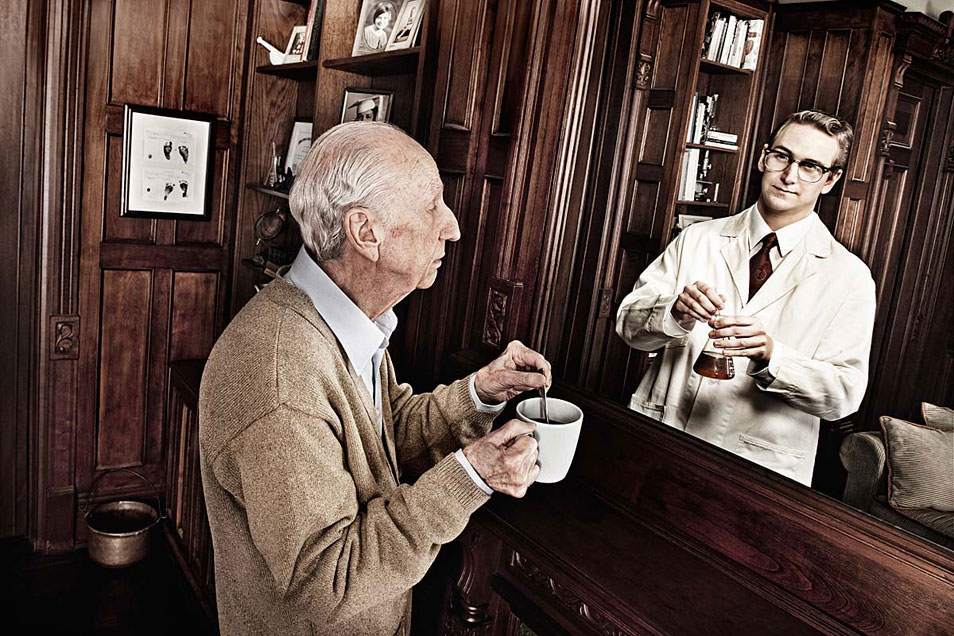
The other day, as I was casually killing a few minutes browsing about the internet, I happened across this website that reminded me of Lewis Carroll's Through the Looking Glass. Photographer Tom Hussey was hired by the pharmaceutical company Novartis to create a series of advertisements for a drug that helps patients maintain long term memory during Alzheimer's.
Included in this post are a few samples of Hussey's work for the campaign, but to see more click here.
This reminded me of Alice's adventure immediately due to the power of the looking glass. In Alice's story, she is transported to another crazy world, while in Hussey's art the mirror provides a transport back to a time that was. I thoroughly enjoy this, because a mirror is thought of as just reflecting the present, but both Carroll and Hussey see it as a means for taking what is, and bending it to an alternate reality. In these cases, the looking glass serves as a reminder or what was or what could be, and yet still maintains a bent version of reality. For example, Alice believes her kitten was the queen - a connection between the mirror world and her life - and the man in the first picture sees his coffee cup as a flask - a connection between his current life and his life in the past as a scientist.
I know this subject matter jumps a bit back to Alice and Through the Looking Glass in our first few weeks of class, but when I saw these images I could not resist posting about them. Hopefully they can serve as a reminder to us of the beauty and fantasy of looking past the current and obvious.
Questions for John Crowley
1. The Washington Post Book World commented that Little Big is "... a love story of very great intensity..." However, I take it to be an intense story that involves more sexuality as opposed to love. What role did you intend for love to play in this book? Is it a love story or a story that involves sexuality?
2. Do you believe in the Tale? If not, was it challenging to write a novel so centered around it?
3. In regards to the faeries, why is it that only some people can see them, and those that can see them are not necessarily those that most desire to see into the inner spheres?
4. Jumping back to the beginning, why did you start of the entire book with Chesterton's quote "Men are men, but Man is a woman"? Did you intend to make this a book that largely addresses and questions gender roles?
5. On the contents page, it says:
6. Do you genuinely believe that the further in you go, the bigger it gets? Was there something in your world that occurred to cause you to make this realization, or did it just work with the book? Was this the primary basis when you initially began writing the book? How did it evolve over the writing period?
2. Do you believe in the Tale? If not, was it challenging to write a novel so centered around it?
3. In regards to the faeries, why is it that only some people can see them, and those that can see them are not necessarily those that most desire to see into the inner spheres?
4. Jumping back to the beginning, why did you start of the entire book with Chesterton's quote "Men are men, but Man is a woman"? Did you intend to make this a book that largely addresses and questions gender roles?
5. On the contents page, it says:
LITTLE, BIG
or,
The Fairies' Parliament
is that an alternate title you came up with? Does it / how would The Fairies' Parliament fit as a more adequate title of the novel?6. Do you genuinely believe that the further in you go, the bigger it gets? Was there something in your world that occurred to cause you to make this realization, or did it just work with the book? Was this the primary basis when you initially began writing the book? How did it evolve over the writing period?
Thursday, October 4, 2012
Be Happy
"The Things that Make us Happy
Make us Wise." (Crowley 22).
This quote from John Crowley's Little Big stopped me dead in my tracks while reading. Especially in the reading for a college class - where we are supposed to be gaining wisdom, but do not associate it with happiness - I was unsure what to make of it.
It brought up three questions:
1. What is happiness?
2. What is wisdom and how does is vary from knowledge?
3. How does happiness create wisdom?
So I guess the first step is to figure out what is happiness. At this point it would be easy to jump to the dictionary definition, but it is too broad. There are so many types of happiness; one can be joyful, excited, gleeful, blissful, ecstatic, pleased, and the list just goes on and on. Therefore, I suppose the question of "What is happiness?" might just be a bit too broad.
However, I do believe we can then ask the different question of what makes us happy? I think it is safe to say that happiness comes with non-material goods. Looking back on my life, I find, and I hold this to be true for humanity as a whole, that true happiness comes with interactions. Whether these interactions are between people or with the environment or with some sort of challenge being faced, it is what pushes us and we are able to overcome and grow that makes us truly happy. That can be a friend just being there for you and having a good laugh. It can be reaching the top of a mountain in spite of its steep terrain. It can be finally solving that math problem you have been staring at for days. It is when we are challenged and growing through success that we find true, lasting happiness. Material goods can help us on our way and be a tool to be happy, but ultimately they cannot push us and encourage us in the way that others and ourselves can.
This then leads to the question of wisdom. I distinguish between wisdom and knowledge and wisdom in the way that wisdom has to do with understanding, whereas knowledge is recitation of fact. As August puts it in Little, Big, "Now knowledge was there to be had, real knowledge, knowledge of how the world operates and what must be done to operate it. Operate" (Crowley 102). August is out to know, but he lacks the curiosity to understand what it is that way. In my opinion, knowledge is comprised of fact, and wisdom goes deeper than the facts to discover how they work together and why it is.
So how do the things that make us happy also make us wise? Experience. It is the experiences that make us happy that also make us wise. In doing the things that make us happy (as discussed above), we create a greater understanding of the workings of the world because we are experiencing them first hand. In addition, when something makes us happy, we are naturally drawn to it and want to know more about it in hopes of maximizing our happiness, and, therefore, discover more about it and its inner-workings and begin to understand it, growing wiser. However, sometimes our understanding boils down to the appreciation that it cannot be fully understood, and there we are wise in learning the vastness of the world and the limits of our own human minds.
I believe it all boils down to experience. It is what Dr. Bramble seeked in regards to the fairies, a first hand experience, and yet he could not get it. Therefore, he knew some facts from Violet, but he failed to appreciate the whole existence because he could not see for himself. He has knowledge, but not wisdom. In the end, happiness is an outcome of experience, and an advocate for more experience, so the things that make us happy allow for a deeper understanding that makes us wise.
Subscribe to:
Posts (Atom)